

Quirk (Bass Clarinet and Computer)
2010
Duration 9'
In much of the music I write, the title comes first and has tremendous impact on the resultant score. When I set out to write a piece for virtuoso clarinetist Mauricio Salguero, the word "quirk" came to mind. Something about the sound of it reminds me of the low notes of the bass clarinet, particularly when played with slap-tongue. Messrs. Merriam and Webster define "quirk" as "a peculiar trait." For me, the word always carries a further, slightly negative connotation, as if these idiosyncratic traits are just a little bit dirty – the sort of thing any decent person would keep under wraps. Nevertheless, as a composer, my quirks are an abiding love of groove and popular music, as well as an on-again, off-again romance with post-minimalist developmental techniques, and something of an infatuation with granular processing. The piece Quirk explores all of these in depth. It's just as well: the second definition of "quirk" is "a groove separating a bead or other molding from adjoining members," so even our lexicographers see the links between quirks and grooves.
Please note: the sound file below is a quick demo recording of the work, performed by Mauricio Salguero. We anticipate returning to the studio within the next few months to re-record the track for eventual release on CD.
Please contact me to obtain the Max 5 files needed to perform Quirk. You will also need Max Runtime, available from Cycling '74.


Phantasm (Alto Saxophone and Computer)
2008
Duration 8'
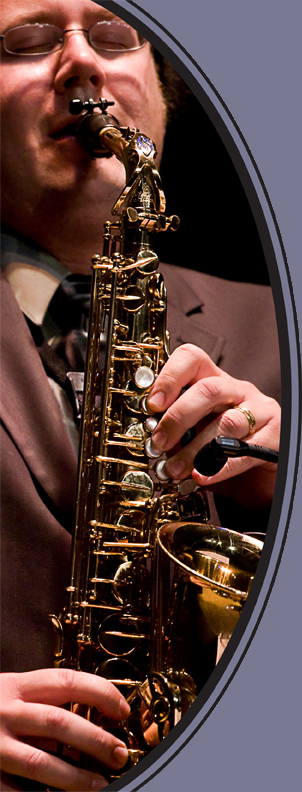
Phantasm for alto saxophone and computer explores connections between old and new, between high-tech urban sounds and low-tech, rural folk sounds, and between memory and imagination. The piece is rooted in an earlier work of mine for solo saxophone. I was struck by the idea of a revenant – a sort of fragmentary remnant of a ghost – and the somewhat tenuous connections between an existing recording and a new, granularly processed version of the same recording. The materials of Phantasm are exactly these sorts of ghostly fragments: the live saxophone part is derived throughout from the earlier work, but with the materials twisted and bent into new, haunting shapes, distorted through extended saxophone performance techniques. The computer makes use of pre-recorded materials as well as live granular processing of the saxophone to create washes and clouds of sound. The first large section of the work, "Digital Ritual," serves to call the phantasm forth and repeatedly, ritualistically pairs samples of Kenyan Nyatiti harp with various rhythm patterns derived from the West African bembe. As time goes by, these rural, traditional sounds are wrenched into the 21st century, undergoing extremes of digital distortion and aliasing noise as the saxophone's invocation grows more and more frenetic and intense. The second large section of the work, "Phantasm," places a new saxophone line in counterpoint against the revenant of the older, original saxophone recording. Both old and new feature extensive granular processing, to blur the edges between them and achieve a new synthesis of texture and timbre.
Please note: the sound file below is an excerpt of the full track, which is available on the forthcoming DVD, Phantasm (Fall 2010).
Ceteris Paribus (Trumpet & Computer)
2007
Duration 10'40"'
Economists use the phrase "ceteris paribus" frequently. It means "all other things being equal," and they use it when they ignore certain aspects of a situation they study, to focus on the particular causal relationships in which they are interested. I was struck by the sound and meaning of the phrase and decided to compose a piece for trumpet in which each section would explore a specific change while holding other variables constant. The piece is quite systematic in its development, and is patterned on multiple levels by the concept of "all other things being equal." The computer serves to focus attention on the concept as it also uses great economy of means – essentially nothing but variations on the technique of granular processing – and adds enormous complexity to the music without actually bringing anything new to the table. In the same way that the written music for the trumpet results from straightforward compositional processing of germinal materials, the accompanying sound from the speakers is entirely derived from the live performer in real time: all other things being equal, that input causes the sounding output.
Dreamtime (Didgeridoo and Computer)
2004
Duration 8'40"
The Dreamtime is the Aboriginal concept of the time before and surrounding the birth of the world. All that ever was or will be existed, nascently, in the Dreamtime. If current popular culture had a dreamtime, how would it sound? Dreamtime for didgeridoo and computer explores the sonic connections between the Dreamtime and the urban world.
Concertpiece "House" (Piano or Marimba)
1999, rev. 2002
Duration 9'
I began composing this piece in 1997 for marimbist Michael Overman. The piece has a rather varied history and has seen several incarnations. It started with a request by Mr. Overman for a piece for solo marimba. As the title is often the starting point for my music, I tried to have fun with this piece by asking two different people for one word each. I asked the first for her favorite adjective. She said “macabre.” I asked the second for her least favorite noun. The answer came back “doily.” Putting the two together, the piece became Macabre Doily. While the opening flurries of notes reminded me of lace, the piece quickly grew away from the title, leading me to title it Concertpiece (“He Shouts, He Stomps”). This title was a reference to a work by a friend of mine titled She Sings, She Screams, and also reflected the fact that the piece, in that incarnation, called for the marimbist to stomp and shout as well as play the marimba. Eventually, I did away with the extraneous noises and concentrated on the marimba part. I retained the Concertpiece part of the title, as the work is intended to be a concertpiece, and added the word “house”to refer to the fact that the piece bears the influence of house music. The fusion of popular idioms with “classical” music is a field of great interest to me. That version of the work was completed in 1999. Since then, I decided to rework the piece for piano, resulting in this latest version, which was premiered by Winston Choi at Northwestern University in May, 2002.
Tab A/Slot B (Drum Set)
2000
Duration 4'30"
Tab A/Slot B gets its title from the common instructions for assembling paper products—”insert tab A into slot B.” The idea of inserting things carried the piece from its genesis as a random collection of two- and three-beat attacks through to the final touches. The form of the piece is developmental, using the idea of insertion—or interpolation—to generate the metric structure of each of eight sections. When each of the measures in the first section has been expanded by the insertion of extra music, the piece is over, barring a final measure to contain the last note. This piece also draws in large part upon my own experience in playing drum set with a number of garage rock bands and cover bands. My philosophy in drumming was always to hit stuff as often and as loudly as possible, within the musical context. Given the opportunity to create the context singlehandedly, it is no surprise that the soloist for this piece gets to hit everything extremely often and extremely loudly.
Instant Vacation (Alto Saxophone)
1998, rev. 2001
Duration 10'
Winner, 2004 American University Saxophone Symposium Composition Contest
Finalist, 1999 ASCAP Morton Gould Awards to Young Composers
Instant Vacation is a collection of concrete images. Each of the movements conveys and develops my initial aural response to its title. The music is not programmatic – there is no story to be told – but the connections between the notes on the pages and the titles range from the obvious (e.g. aleatoric techniques in Random Crow) to the esoteric. Of course, the title of the full work is likewise meaningful: at the very least, the difficulty of the last movement leads the saxophonist to feel as though the end of the work consitutes the beginning of a vacation.
Any of the three movements may be performed alone or in pairs if the performer does not wish to perform all three. An explanation of special notation will be found in the first movement. Fingerings for multiphonics and microtones are found next to the usage.
Movement I: Random Crow
Movement II: Far Hound
Movement III: Attentive Magpie
Didjeriduet (Alto Saxophone & Computer)
1997
Duration 9'
A challenging piece for alto saxophone and fixed media, the electronic sounds are entirely derived from the wide variety of sounds possible on a didgeridoo.
Conversational Annoyances I: The Mumbler (Trombone)
1996
Duration 5'
Graphic score for solo trombone, based on a fictional conversation. Contact me for the score; not currently available as PDF.

